Не коннектится Tor
Debian GNU/Linux 10 (buster). Установил Tor browser. запускается и не коннектится. Появляется окно с заголовком Connect to Tor и дальше дело не идет. В чем может быть дело?

Оператор заблокировал tor, очевидно же. Как обстоят дела с доступом через obfs4 и прочие мосты?

Мосты используй, я уже год точно не могу тором напрямую пользоваться

Ну лог-то посмотри, ну. И покажи сюда.
А что, уже начали? У ростелекома пока с этим проблем нет, тьфу тьфу тьфу.
А в обычном браузере, через proxy: SOCKS4/5 Узел SOCKS localhost:9050, коннектится?

браузер не нужен, использую голый tor — прописываю в проксю socks://localhost:9050 и погнали. телеком, дом.ру, р-нет по витой паре полет нормальный, а в теле2 по воздуху не работает.
А потом по перехваченным заголовкам и прочим небезопасным опциям тебя деанонят и сажают на сгуху, хоть под тысячу слоями лука.

прописываю в проксю socks://localhost:9050
Ага и ДНС запросы мимо сети ТОР. Тащ майор, что же вы так палитесь?
я так делаю, что бы обойти блокировки роскомнадзора и попасть на сайты которые не легально распространяют книги донцовой и фильмы михалкова — в общем нифига мне за это не будет.
ДНС запросы мимо сети ТОР. Тащ майор
для товарища майора это слишком сложно, вообще вся эта деанонизация сильно преувеличена, просто некоторые идиоты создают аки во вконтакте из настоящих имен, фамилий и даже фотографий, что значительно упрощает процесс.
Там же галочка, даже по умолчанию, вроде. А последние браузеры уже сами предпочитают DNS-over-HTTPS.

У тебя в настройках лисы есть это:
— Отправлять DNS-запросы через прокси при использовании SOCKS
— Включить DNS через HTTPS
У ростелекома пока с этим проблем нет
Как раз таки с ростелекомом была проблема как у топикстартера, напрямую тор не ходил — и сервис, тор браузер.
Средство разблокировки тора при наличии другого прокси — прописать в torrc:
— позволяет иметь доступ к тор если тор трафик заблокирован провайдером

пару недель назад была такая же проблема, причем только с конектом к входным бриджам и только под шиндой, с линукса всё работало, причем не пахало даже obfs4, пришлось юзать впн для конекта к бриджу, далее уже всё норм работало и так

Должно быть, вы пишите из параллельной вселенной, в которой учли идею 
alexferman , но что-то перепутали и вместо Cities Skylines, начали играть в Frostpunk.
Браузер TOR не открывается или не работает в Windows 11 или 10
Если вы устали от ограничений и не можете свободно заходить на веб-сайты, я предлагаю вам воспользоваться VPN. В настоящее время Surfshark является одним из лучших и работающих вариантов. Ознакомьтесь с сервисом здесь и заключите сделку прямо сейчас. У вас есть гарантия возврата денег в течение 30 дней.
Большинство пользователей ПК знакомы с браузером TOR , особенно пользователи, которые являются «приверженцами» конфиденциальности в Интернете . Если у вас есть браузер, успешно установленный в вашей системе, но вы заметили, что браузер TOR не открывается и не работает на вашем ПК с Windows 11 или Windows 10, то этот пост предназначен для того, чтобы помочь вам с решениями или предложениями по приведению браузера в работоспособное состояние. которые могут позволить вам получить доступ к Dark Web, если вам нужно.

Наиболее вероятными виновниками проблемы являются следующие:
- Плохое интернет-соединение.
- Цензура интернет-провайдеров
- Вредоносное ПО / вирусное заражение.
- Неправильная дата и время на компьютере.
- Работает несколько экземпляров приложения Tor.
Браузер TOR не открывается или не работает в Windows 11 или 10
Если вы столкнулись с проблемой, когда браузер TOR не открывается или не работает в Windows 11/10, вы можете попробовать наши рекомендуемые решения ниже в произвольном порядке и посмотреть, поможет ли это решить проблему.
Прежде чем приступить к решениям, приведенным ниже, вам необходимо убедиться, что часы вашего компьютера с Windows установлены на правильную дату и время . Кроме того, одновременно может работать только один экземпляр TOR, поэтому проверьте, запущен ли уже TOR в диспетчере задач. Если вы не уверены, вы можете просто перезагрузить компьютер. А если ваша система только что вышла из спящего или спящего режима, перезапустите браузер TOR или перезагрузите компьютер.
1. Назначьте разрешение на полный доступ к папке браузера TOR
Вы можете получить следующее сообщение об ошибке после установки TOR и попытки запустить браузер;
Браузер Tor не имеет разрешения на доступ к профилю. Измените разрешения файловой системы и повторите попытку.
В этом случае вы можете решить эту проблему, назначив разрешение «Полный доступ» для папки браузера TOR, а затем перезапустив браузер. По умолчанию TOR устанавливается в следующем месте на вашем локальном диске:
C: \ Program Files \ Tor Browser \ Браузер
Если это не сработало, попробуйте следующее решение.
2. Отключить программное обеспечение безопасности
Программное обеспечение безопасности (особенно от сторонних поставщиков), работающее на вашем ПК с Windows, может неправильно помечать браузер TOR, блокируя его открытие или правильную работу. В этом случае вам нужно будет внести TOR в белый список или отключить программное обеспечение безопасности.
Вы можете временно отключить Microsoft Defender, если это программное обеспечение безопасности, которое вы используете в своей системе. Также убедитесь, что TOR разрешен через брандмауэр Windows .
Если у вас установлено стороннее программное обеспечение безопасности, отключение программы во многом зависит от программного обеспечения безопасности — см. Руководство по эксплуатации. Как правило, чтобы отключить антивирусное программное обеспечение, найдите его значок в области уведомлений или на панели задач на панели задач (обычно в правом нижнем углу рабочего стола). Щелкните значок правой кнопкой мыши и выберите вариант отключения или выхода из программы.
3. Проверьте подключение к Интернету
Это решение требует, чтобы вы убедились, что у вас нет проблем с подключением к Интернету на вашем компьютере с Windows 11/10. Вы также можете попробовать перезапустить свое интернет-устройство (модем / маршрутизатор) и посмотреть, поможет ли это.
4. Получить новый IP-адрес
Браузер TOR спроектирован таким образом, чтобы работать совершенно по-другому, назначая новый IP-адрес, отличный от того, который назначен вашему компьютеру вашим интернет-провайдером. Если есть проблема с IP-адресом, вы можете столкнуться с этой проблемой. В этом случае вы можете перейти на сайт проекта TOR по адресу check.torproject.org, чтобы узнать, какой IP-адрес вам назначен в настоящее время. На сайте, чтобы получить новый IP-адрес, просто нажмите на палочку в браузере.
5. Убить процесс Firefox
Браузер TOR имеет ДНК Firefox. Итак, в этом случае вам, возможно, придется убить процесс Firefox, прежде чем TOR сможет работать на вашем компьютере с Windows 11/10. Кроме того, вы также можете перезапустить процесс проводника .
6. Удалить файл parent.lock
Чтобы удалить файл parent.lock на вашем ПК с Windows, сделайте следующее:
- Нажмите клавишу Windows + E, чтобы открыть проводник .
- Перейдите в указанное ниже место:
C: \ Users \ UserName \ Desktop \ Tor Browser \ Browser \ TorBrowser \ Data \ Browser \ profile.default
- Прокрутите папку и найдите файл parent.lock .
- Выберите файл и нажмите клавишу УДАЛИТЬ на клавиатуре. Кроме того , вы можете щелкнуть правой кнопкой мыши на файл и выберите Удалить из контекстного меню.
- Закройте проводник.
- Посмотрите, исправлена ли проблема с браузером TOR. Если нет, попробуйте следующее решение.
7. Удалите и переустановите браузер TOR
Это решение требует, чтобы вы удалили или удалили браузер TOR следующим образом:
- Найдите папку или приложение вашего браузера Tor.
- Местоположение по умолчанию — Рабочий стол.
- Удалите папку или приложение Tor Browser.
- Очистите корзину.
- Вот и все! TOR удален! В этом случае нет необходимости использовать панель управления.
Теперь перезагрузите компьютер, а затем загрузите и переустановите последнюю версию браузера на свой компьютер с Windows 11/10.
8. Используйте другой конфиденциальный браузер
Это скорее обходной путь, чем решение. Это влечет за собой использование другого браузера конфиденциальности .
9. Свяжитесь с вашим интернет-провайдером
Возможно, ваш интернет-провайдер заблокировал браузер TOR — интернет-провайдеры собирают данные и отслеживают входящий и исходящий трафик вашей системы Windows по разным причинам. а браузер TOR из-за настроек конфиденциальности обычно блокирует этот трафик. В этом случае вы можете связаться с вашим интернет-провайдером, чтобы убедиться, что TOR не заблокирован для вас.
10. Обратитесь в службу поддержки TOR
Если ваш интернет-провайдер не заблокировал TOR, и вы также исчерпали все другие параметры, но проблема не устранена, вы можете найти свой журнал TOR, скопировать и вставить журналы в Блокнот, чтобы вы могли просмотреть и проанализировать результаты журнала самостоятельно или отправьте его в службу поддержки TOR, чтобы помочь в диагностике проблемы и, возможно, предложении исправления.
Чтобы просмотреть журналы TOR, выполните следующие действия.
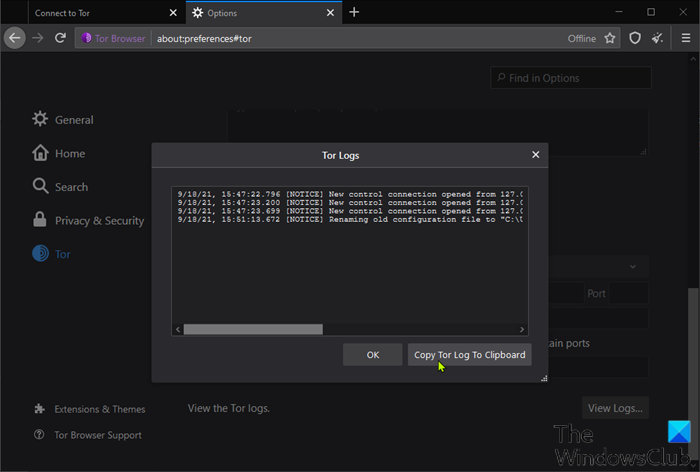
- Откройте браузер TOR.
- Щелкните гамбургер-меню (три вертикальные линии) в правом верхнем углу браузера.
- Выберите Параметры .
- Щелкните Tor на левой навигационной панели.
- На правой панели прокрутите вниз и нажмите Просмотр журналов .
- Щелкните Копировать журнал Tor в буфер обмена .
- Теперь откройте Блокнот и вставьте содержимое в текстовый редактор.
Теперь вы можете проанализировать данные, чтобы выяснить, с какой проблемой работает браузер.
Как использовать браузер Tor
Как и в любом браузере, вы просто вводите URL-адрес в адресную строку и нажимаете Enter, чтобы перейти на нужный веб-сайт. Строка рядом с адресной строкой — это панель быстрого поиска. Это позволяет вам выбирать веб-сайты, такие как Google, Amazon, Bing, Twitter, Wikipedia и другие. После выбора веб-сайта, который вы хотите найти, введите поисковый запрос и нажмите клавишу Enter.
Вы можете нажать кнопку Tor (значок лука слева от браузера Tor), чтобы настроить файлы cookie Tor и другие настройки.
Вы можете дополнительно настроить свои предпочтения в отношении конфиденциальности, выбрав поведение Tor при просмотре InCognito. Нажмите кнопку Tor Browser в строке заголовка Tor Browser и в появившемся подменю нажмите «Параметры» и снова «Параметры». В появившемся диалоговом окне перейдите на вкладку Конфиденциальность. На этой вкладке вы можете указать, хотите ли вы сохранять файлы cookie, историю загрузок, пароли и т. д. Вы также можете установить режим Tor, в котором « веб-сайты не должны пытаться отслеживать вас».
Недостатки браузера Tor
Есть только одно — браузер в разы подтормаживает. Это связано с тем, что пакеты данных маршрутизируются через большое количество точек ретрансляции в браузере Tor. Других минусов при просмотре через Tor я не нашел. Кроме того, на некоторых сайтах вам может потребоваться разрешить скрипты с помощью значка S непосредственно перед адресной строкой. Такие сайты, как Facebook и Twitter, широко используют скрипты, поэтому вы можете столкнуться с проблемами, если запустите Tor с заблокированными скриптами. Вы можете переключать блокировку/разрешение скриптов с помощью кнопки S.
Работает ли браузер TOR в Windows 10?
Да, браузер TOR работает в Windows 11/10. Фактически, самая последняя версия браузера, версия 10.4.6, совместима с даже более ранними версиями Windows. Следует отметить, что процесс настройки практически одинаков для всех операционных систем Windows, поэтому вы все равно можете запускать старые версии браузера в своей системе без каких-либо проблем.
Как исправить неожиданный выход из TOR?
Если вы получаете сообщение об ошибке, в котором говорится, что TOR неожиданно завершился, это, скорее всего, связано с ошибкой, присутствующей в самом браузере TOR, другой программой в вашей системе или неисправным оборудованием. Чтобы быстро решить эту проблему, вы можете перезапустить браузер. Если проблема не исчезнет, вы можете отправить копию журнала TOR в службу поддержки и, надеюсь, решить проблему.
Tor not connected что делать
Completing the CAPTCHA proves you are a human and gives you temporary access to the web property.
What can I do to prevent this in the future?
If you are on a personal connection, like at home, you can run an anti-virus scan on your device to make sure it is not infected with malware.
If you are at an office or shared network, you can ask the network administrator to run a scan across the network looking for misconfigured or infected devices.
Another way to prevent getting this page in the future is to use Privacy Pass. You may need to download version 2.0 now from the Chrome Web Store.
Cloudflare Ray ID: 71a84b9188529170 • Your IP : 82.102.23.104 • Performance & security by Cloudflare
Relay Operators
Tor will only need access to the medium term signing key and certificate as long as they are valid, so the primary identity secret key can be kept outside DataDirectory/keys, on a storage media or a different computer. You’ll have to manually renew the medium term signing key and certificate before they expire otherwise the Tor process on the relay will exit upon expiration.
This feature is optional, you don’t need to use it unless you want to. If you want your relay to run unattended for longer time without having to manually do the medium term signing key renewal on regular basis, best to leave the primary identity secret key in DataDirectory/keys, just make a backup in case you’ll need to reinstall it. If you want to use this feature, you can consult our more detailed guide on the topic.
-
Contributors to this page: cypherpunk
- Edit this page — Suggest Feedback — Permalink
Can I use IPv6 on my relay?
Tor has partial support for IPv6 and we encourage every relay operator to enable IPv6 functionality in their torrc configuration files when IPv6 connectivity is available. For the time being Tor will require IPv4 addresses on relays, you can not run a Tor relay on a host with IPv6 addresses only.
-
Contributors to this page: cypherpunk
- Edit this page — Suggest Feedback — Permalink
Why does my relay write more bytes onto the network than it reads?
You’re right, for the most part a byte into your Tor relay means a byte out, and vice versa. But there are a few exceptions:
If you open your DirPort, then Tor clients will ask you for a copy of the directory. The request they make (an HTTP GET) is quite small, and the response is sometimes quite large. This probably accounts for most of the difference between your «write» byte count and your «read» byte count.
Another minor exception shows up when you operate as an exit node, and you read a few bytes from an exit connection (for example, an instant messaging or ssh connection) and wrap it up into an entire 512 byte cell for transport through the Tor network.
-
Contributors to this page: cypherpunk
- Edit this page — Suggest Feedback — Permalink
How stable does my relay need to be?
We aim to make setting up a Tor relay easy and convenient:
- It’s fine if the relay goes offline sometimes. The directories notice this quickly and stop advertising the relay. Just try to make sure it’s not too often, since connections using the relay when it disconnects will break.
- Each Tor relay has an exit policy that specifies what sort of outbound connections are allowed or refused from that relay. If you are uncomfortable allowing people to exit from your relay, you can set it up to only allow connections to other Tor relays.
- Your relay will passively estimate and advertise its recent bandwidth capacity, so high-bandwidth relays will attract more users than low-bandwidth ones. Therefore, having low-bandwidth relays is useful too.
-
Contributors to this page: cypherpunk
- Edit this page — Suggest Feedback — Permalink
Why can I not browse anymore after limiting bandwidth on my Tor relay?
The parameters assigned in the AccountingMax and BandwidthRate apply to both client and relay functions of the Tor process. Thus you may find that you are unable to browse as soon as your Tor goes into hibernation, signaled by this entry in the log:
The solution is to run two Tor processes — one relay and one client, each with its own config. One way to do this (if you are starting from a working relay setup) is as follows:
- In the relay Tor torrc file, simply set the SocksPort to 0.
- Create a new client torrc file from the torrc.sample and ensure it uses a different log file from the relay. One naming convention may be torrc.client and torrc.relay.
- Modify the Tor client and relay startup scripts to include -f /path/to/correct/torrc .
- In Linux/BSD/Mac OS X, changing the startup scripts to Tor.client and Tor.relay may make separation of configs easier.
-
Contributors to this page: cypherpunk
- Edit this page — Suggest Feedback — Permalink
How do I decide if I should run a relay?
We’re looking for people with reasonably reliable Internet connections, that have at least 10 Mbit/s (Mbps) available bandwidth each way. If that’s you, please consider running a Tor relay.
Even if you do not have at least 10 Mbit/s of available bandwidth you can still help the Tor network by running a Tor bridge with obfs4 support. In that case you should have at least 1 MBit/s of available bandwidth.
-
Contributors to this page: cypherpunk
- Edit this page — Suggest Feedback — Permalink
I’m behind a NAT/Firewall.
See portforward.com for directions on how to port forward with your NAT/router device.
If your relay is running on a internal net, you need to setup port forwarding. Forwarding TCP connections is system dependent but the firewalled-clients FAQ entry offers some examples on how to do this.
Also, here’s an example of how you would do this on GNU/Linux if you’re using iptables:
/sbin/iptables -A INPUT -i eth0 -p tcp —destination-port 9001 -j ACCEPT
You may have to change «eth0» if you have a different external interface (the one connected to the Internet). Chances are you have only one (except the loopback) so it shouldn’t be too hard to figure out.
-
Contributors to this page: cypherpunk
- Edit this page — Suggest Feedback — Permalink
How do I change my bridge distribution method?
BridgeDB implements four mechanisms to distribute bridges: HTTPS, Moat, Email, and Reserved. Bridge operators can check which mechanism their bridge is using, on the Relay Search. Enter the bridge’s <HASHED FINGERPRINT> in the form and click «Search».
Operators can also choose which distribution method their bridge uses. To change the method, modify the BridgeDistribution setting in the torrc file to one of these: https, moat, email, none, any.
Read more on the Bridges post-install guide.
-
Contributors to this page: cypherpunk
- Edit this page — Suggest Feedback — Permalink
Do I get better anonymity if I run a relay?
Yes, you do get better anonymity against some attacks.
The simplest example is an attacker who owns a small number of Tor relays. They will see a connection from you, but they won’t be able to know whether the connection originated at your computer or was relayed from somebody else.
There are some cases where it doesn’t seem to help: if an attacker can watch all of your incoming and outgoing traffic, then it’s easy for them to learn which connections were relayed and which started at you. (In this case they still don’t know your destinations unless they are watching them too, but you’re no better off than if you were an ordinary client.)
There are also some downsides to running a Tor relay. First, while we only have a few hundred relays, the fact that you’re running one might signal to an attacker that you place a high value on your anonymity. Second, there are some more esoteric attacks that are not as well-understood or well-tested that involve making use of the knowledge that you’re running a relay — for example, an attacker may be able to «observe» whether you’re sending traffic even if they can’t actually watch your network, by relaying traffic through your Tor relay and noticing changes in traffic timing.
It is an open research question whether the benefits outweigh the risks. A lot of that depends on the attacks you are most worried about. For most users, we think it’s a smart move.
-
Contributors to this page: cypherpunk
- Edit this page — Suggest Feedback — Permalink
My relay recently got the Guard flag and traffic dropped by half.
Since it’s now a guard, clients are using it less in other positions, but not many clients have rotated their existing guards out to use it as a guard yet. Read more details in this blog post or in Changing of the Guards: A Framework for Understanding and Improving Entry Guard Selection in Tor.
-
Contributors to this page: cypherpunk
- Edit this page — Suggest Feedback — Permalink
Why do I get portscanned more often when I run a Tor relay?
If you allow exit connections, some services that people connect to from your relay will connect back to collect more information about you. For example, some IRC servers connect back to your identd port to record which user made the connection. (This doesn’t really work for them, because Tor doesn’t know this information, but they try anyway.) Also, users exiting from you might attract the attention of other users on the IRC server, website, etc. who want to know more about the host they’re relaying through.
Another reason is that groups who scan for open proxies on the Internet have learned that sometimes Tor relays expose their socks port to the world. We recommend that you bind your socksport to local networks only.
In any case, you need to keep up to date with your security. See this article on security for Tor relays for more suggestions.
-
Contributors to this page: cypherpunk
- Edit this page — Suggest Feedback — Permalink
My relay or bridge is overloaded what does this mean?
On relay search we show an amber dot next to the relay nickname when it is overloaded. This means that one or many of the following load metrics have been triggered:
Note that if a relay reaches an overloaded state we show it for 72 hours after the relay has recovered.
If you notice that your relay is overloaded please:
Check https://status.torproject.org/ for any known issues in the «Tor network» category.
Consider tuning sysctl for your system for network, memory and CPU load.
Consider enabling MetricsPort to understand what is happening.
Tuning sysctl for network, memory and CPU load
TCP port exhaustion
If you are experiencing TCP port exhaustion consider expanding your local port range. You can do that with
# sysctl -w net.ipv4.ip_local_port_range=»15000 64000″
# echo 15000 64000 > /proc/sys/net/ipv4/ip_local_port_range
Keep in mind that tuning sysctl as described is not permanent and will be lost upon restart. You need to add the configuration to /etc/sysctl.conf or to a file in /etc/sysctl.d/ to make it permanent.
MetricsPort
To understand the well-being of Tor relays and the Tor network it is vital to provide and have access to relay metrics. Relay overload information has been added to relay descriptors since 0.4.6+ but it was not until Tor >= 0.4.7.1-alpha that an interface to the underlying relay metrics was available: the metrics port.
Enabling MetricsPort
Tor provides access to the metrics port via a torrc configuration option called MetricsPort .
It’s important to understand that exposing the tor MetricsPort publicly is dangerous for the Tor network users, which is why that port is not enabled by default and its access has to be governed by an access policy. Please take extra precaution and care when opening this port, and close it when you are done debugging.
Let’s assume you are the only user on a server that runs a Tor relay. You can enable the metrics port adding this to your torrc file:
And then you will be able to easily retrieve the metrics with:
which are by default in a Prometheus format.
Note: every user on that server will be able to access those relay metrics in the example above. In general, set a very strict access policy with MetricsPortPolicy and consider using your operating systems firewall features for defense in depth.
For a more detailed explanation about MetricsPort and MetricsPortPolicy see tor’s man page.
MetricsPort output
Here is an example of what output enabling MetricsPort will produce:
Let’s find out what some of these lines actually mean:
tor_relay_load_onionskins_total 0
When a relay starts seeing «dropped», it is a CPU/RAM problem usually.
Tor is sadly single threaded except for when the «onion skins» are processed. The «onion skins» are the cryptographic work that needs to be done on the famous «onion layers» in every circuits.
When tor processes the layers we use a thread pool and outsource all of that work to that pool. It can happen that this pool starts dropping work due to memory or CPU pressure and this will trigger an overload state.
If your server is running at capacity this will likely be triggered.
tor_relay_exit_dns_error_total
Any counter in the «*_dns_error_total» realm indicates a potential DNS related problem. However, we realized during the 0.4.7 release cycle that DNS errors are way too noisy and contain too many false positives to be useful for overload reporting purposes. We therefore don’t use them anymore for that purpose starting with 0.4.6.9 and 0.4.7.4-alpha. However, we still keep DNS metrics around to give the relay operator insight into what is going on with their relay.
DNS timeout issues and errors only apply to Exit nodes.
tor_relay_load_oom_bytes_total
An Out-Of-Memory invocation indicates a RAM problem. The relay might need more RAM or it is leaking memory. If you noticed that the tor process is leaking memory, please report the issue either via Tor gitLab or sending an email to the tor-relays mailing list.
Tor has its own OOM handler and it is invoked when 75%, of the total memory tor thinks is available, is reached. Thus, let say tor thinks it can use 2GB in total then at 1.5GB of memory usage, it will start freeing memory. That is considered an overload state.
To estimate the amount of memory it has available, when tor starts, it will use MaxMemInQueues or, if not set, will look at the total RAM available on the system and apply this algorithm:
To avoid an overloaded state we recommend to run a relay above 2GB of RAM on 64bit. 4GB is advised, although of course it doesn’t hurt to add more RAM if you can.
One might notice that tor could be called by the OS OOM handler itself. Because tor takes the total memory on the system when it starts, if the overall system has many other applications running using RAM, it ends up eating too much memory. In this case the OS could OOM tor, without tor even noticing memory pressure.
tor_relay_load_socket_total
These lines indicate the relay is running out of sockets. The solution is to increase ulimit -n for the tor process.
tor_relay_load_tcp_exhaustion_total
These lines indicate the relay is running out of TCP ports.
Try to tune sysctl as described above.
tor_relay_load_global_rate_limit_reached_total
If this counter is incremented by some noticeable value over a short period of time, the relay is congested. It is likely being used as a Guard by a big onion service or for an ongoing DDoS on the network.
If your relay is still overloaded and you don’t know why, please get in touch with network-report@torproject.org. You can encrypt your email using network-report OpenPGP key.
-
Contributors to this page: cypherpunk
- Edit this page — Suggest Feedback — Permalink
How can I limit the total amount of bandwidth used by my Tor relay?
The accounting options in the torrc file allow you to specify the maximum amount of bytes your relay uses for a time period.
This specifies when the accounting should reset. For instance, to setup a total amount of bytes served for a week (that resets every Wednesday at 10:00am), you would use:
This specifies the maximum amount of data your relay will send during an accounting period, and the maximum amount of data your relay will receive during an account period. When the accounting period resets (from AccountingStart), then the counters for AccountingMax are reset to 0.
Example: Let’s say you want to allow 50 GB of traffic every day in each direction and the accounting should reset at noon each day:
Note that your relay won’t wake up exactly at the beginning of each accounting period. It will keep track of how quickly it used its quota in the last period, and choose a random point in the new interval to wake up. This way we avoid having hundreds of relays working at the beginning of each month but none still up by the end.
If you have only a small amount of bandwidth to donate compared to your connection speed, we recommend you use daily accounting, so you don’t end up using your entire monthly quota in the first day. Just divide your monthly amount by 30. You might also consider rate limiting to spread your usefulness over more of the day: if you want to offer X GB in each direction, you could set your RelayBandwidthRate to 20*X KBytes. For example, if you have 50 GB to offer each way, you might set your RelayBandwidthRate to 1000 KBytes: this way your relay will always be useful for at least half of each day.
-
Contributors to this page: cypherpunk
- Edit this page — Suggest Feedback — Permalink
I’d run a relay, but I don’t want to deal with abuse issues.
Great. That’s exactly why we implemented exit policies.
Each Tor relay has an exit policy that specifies what sort of outbound connections are allowed or refused from that relay. The exit policies are propagated to Tor clients via the directory, so clients will automatically avoid picking exit relays that would refuse to exit to their intended destination. This way each relay can decide the services, hosts, and networks it wants to allow connections to, based on abuse potential and its own situation. Read the Support entry on issues you might encounter if you use the default exit policy, and then read Mike Perry’s tips for running an exit node with minimal harassment.
The default exit policy allows access to many popular services (e.g. web browsing), but restricts some due to abuse potential (e.g. mail) and some since the Tor network can’t handle the load (e.g. default file-sharing ports). You can change your exit policy by editing your torrc file. If you want to avoid most if not all abuse potential, set it to «reject *:*». This setting means that your relay will be used for relaying traffic inside the Tor network, but not for connections to external websites or other services.
If you do allow any exit connections, make sure name resolution works (that is, your computer can resolve Internet addresses correctly). If there are any resources that your computer can’t reach (for example, you are behind a restrictive firewall or content filter), please explicitly reject them in your exit policy otherwise Tor users will be impacted too.
-
Contributors to this page: cypherpunk
- Edit this page — Suggest Feedback — Permalink
Why isn’t my relay being used more?
If your relay is relatively new then give it time. Tor decides which relays it uses heuristically based on reports from Bandwidth Authorities. These authorities take measurements of your relay’s capacity and, over time, directs more traffic there until it reaches an optimal load. The lifecycle of a new relay is explained in more depth in this blog post. If you’ve been running a relay for a while and still having issues then try asking on the tor-relays list.
-
Contributors to this page: cypherpunk
- Edit this page — Suggest Feedback — Permalink
I want to run more than one Tor relay.
Great. If you want to run several relays to donate more to the network, we’re happy with that. But please don’t run more than a few dozen on the same network, since part of the goal of the Tor network is dispersal and diversity.
If you do decide to run more than one relay, please set the «MyFamily» config option in the torrc of each relay, listing all the relays (comma-separated) that are under your control:
where each fingerprint is the 40 character identity fingerprint (without spaces).
That way, Tor clients will know to avoid using more than one of your relays in a single circuit. You should set MyFamily if you have administrative control of the computers or of their network, even if they’re not all in the same geographic location.
-
Contributors to this page: cypherpunk
- Edit this page — Suggest Feedback — Permalink
Is there a list of default exit ports?
The default open ports are listed below but keep in mind that, any port or ports can be opened by the relay operator by configuring it in torrc or modifying the source code. The default according to src/or/policies.c (line 85 and line 1901) from the source code release release-0.4.6:
-
Contributors to this page: cypherpunk
- Edit this page — Suggest Feedback — Permalink
My relay is picking the wrong IP address.
Tor guesses its IP address by asking the computer for its hostname, and then resolving that hostname. Often people have old entries in their /etc/hosts file that point to old IP addresses.
If that doesn’t fix it, you should use the «Address» config option to specify the IP you want it to pick. If your computer is behind a NAT and it only has an internal IP address, see the following Support entry on dynamic IP addresses.
Also, if you have many addresses, you might also want to set «OutboundBindAddress» so external connections come from the IP you intend to present to the world.
-
Contributors to this page: cypherpunk
- Edit this page — Suggest Feedback — Permalink
My relay is slow, how can I fix it?
Why Relay Load Varies
Tor manages bandwidth across the entire network. It does a reasonable job for most relays. But Tor’s goals are different to protocols like BitTorrent. Tor wants low-latency web pages, which requires fast connections with headroom. BitTorrent wants bulk downloads, which requires using all the bandwidth.
We’re working on a new bandwidth scanner, which is easier to understand and maintain. It will have diagnostics for relays that don’t get measured, and relays that have low measurements.
Why does Tor need bandwidth scanners?
Most providers tell you the maximum speed of your local connection. But Tor has users all over the world, and our users connect to one or two Guard relays at random. So we need to know how well each relay can connect to the entire world.
So even if all relay operators set their advertised bandwidth to their local connection speed, we would still need bandwidth authorities to balance the load between different parts of the Internet.
What is a normal relay load?
It’s normal for most relays to be loaded at 30%-80% of their capacity. This is good for clients: an overloaded relay has high latency. (We want enough relays to so that each relay is loaded at 10%. Then Tor would be almost as fast as the wider Internet).
Sometimes, a relay is slow because its processor is slow or its connections are limited. Other times, it is the network that is slow: the relay has bad peering to most other tor relays, or is a long distance away.
Finding Out what is Limiting a Relay
Lots of things can slow down a relay. Here’s how to track them down.
System Limits
- Check RAM, CPU, and socket/file descriptor usage on your relay
Tor logs some of these when it starts. Others can be viewed using top or similar tools.
Provider Limits
- Check the Internet peering (bandwidth, latency) from your relay’s provider to other relays. Relays transiting via Comcast have been slow at times. Relays outside North America and Western Europe are usually slower.
Tor Network Limits
Relay bandwidth can be limited by a relay’s own observed bandwidth, or by the directory authorities’ measured bandwidth. Here’s how to find out which measurement is limiting your relay:
- Check each of the votes for your relay on consensus-health (large page), and check the median. If your relay is not marked Running by some directory authorities:
- Does it have the wrong IPv4 or IPv6 address?
- Is its IPv4 or IPv6 address unreachable from some networks?
- Are there more than 2 relays on its IPv4 address?
Otherwise, check your relay’s observed bandwidth and bandwidth rate (limit). Look up your relay on Metrics. Then mouse over the bandwidth heading to see the observed bandwidth and relay bandwidth rate.
Here is some more detail and some examples: Drop in consensus weight and Rampup speed of Exit relay.
How to fix it
The smallest of these figures is limiting the bandwidth allocated to the relay.
- If it’s the bandwidth rate, increase the BandwidthRate/Burst or RelayBandwidthRate/Burst in your torrc.
- If it’s the observed bandwidth, your relay won’t ask for more bandwidth until it sees itself getting faster. You need to work out why it is slow.
- If it’s the median measured bandwidth, your relay looks slow from a majority of bandwidth authorities. You need to work out why they measure it slow.
Doing Your Own Relay Measurements
If your relay thinks it is slow, or the bandwidth authorities think it is slow, you can test the bandwidth yourself:
-
to see how fast tor can get on your network/CPU.
-
Contributors to this page: cypherpunk
- Edit this page — Suggest Feedback — Permalink
What type of relays are most needed?
- The exit relay is the most needed relay type but it also comes with the highest legal exposure and risk (and you should NOT run them from your home).
- If you are looking to run a relay with minimal effort, fast guard relays are also very useful
- Followed by bridges.
-
Contributors to this page: cypherpunk
- Edit this page — Suggest Feedback — Permalink
What bandwidth shaping options are available to Tor relays?
There are two options you can add to your torrc file:
BandwidthRate is the maximum long-term bandwidth allowed (bytes per second). For example, you might want to choose «BandwidthRate 10 MBytes» for 10 megabytes per second (a fast connection), or «BandwidthRate 500 KBytes» for 500 kilobytes per second (a decent cable connection). The minimum BandwidthRate setting is 75 kilobytes per second.
BandwidthBurst is a pool of bytes used to fulfill requests during short periods of traffic above BandwidthRate but still keeps the average over a long period to BandwidthRate. A low Rate but a high Burst enforces a long-term average while still allowing more traffic during peak times if the average hasn’t been reached lately. For example, if you choose «BandwidthBurst 500 KBytes» and also use that for your BandwidthRate, then you will never use more than 500 kilobytes per second; but if you choose a higher BandwidthBurst (like 5 MBytes), it will allow more bytes through until the pool is empty.
If you have an asymmetric connection (upload less than download) such as a cable modem, you should set BandwidthRate to less than your smaller bandwidth (Usually that’s the upload bandwidth). Otherwise, you could drop many packets during periods of maximum bandwidth usage — you may need to experiment with which values make your connection comfortable. Then set BandwidthBurst to the same as BandwidthRate.
Linux-based Tor nodes have another option at their disposal: they can prioritize Tor traffic below other traffic on their machine, so that their own personal traffic is not impacted by Tor load. A script to do this can be found in the Tor source distribution’s contrib directory.
Additionally, there are hibernation options where you can tell Tor to only serve a certain amount of bandwidth per time period (such as 100 GB per month). These are covered in the hibernation entry.
Note that BandwidthRate and BandwidthBurst are in Bytes, not Bits.
-
Contributors to this page: cypherpunk
- Edit this page — Suggest Feedback — Permalink
Should I run an exit relay from home?
No. If law enforcement becomes interested in traffic from your exit relay, it’s possible that officers will seize your computer. For that reason, it’s best not to run your exit relay in your home or using your home internet connection.
Instead, consider running your exit relay in a commercial facility that is supportive of Tor. Have a separate IP address for your exit relay, and don’t route your own traffic through it. Of course, you should avoid keeping any sensitive or personal information on the computer hosting your exit relay.
-
Contributors to this page: cypherpunk
- Edit this page — Suggest Feedback — Permalink
How should I configure the outgoing filters on my relay?
All outgoing connections must be allowed, so that each relay can communicate with every other relay.
In many jurisdictions, Tor relay operators are legally protected by the same common carrier regulations that prevent internet service providers from being held liable for third-party content that passes through their network. Exit relays that filter some traffic would likely forfeit those protections.
Tor promotes free network access without interference. Exit relays must not filter the traffic that passes through them to the internet. Exit relays found to be filtering traffic will get the BadExit flag once detected.
-
Contributors to this page: cypherpunk
- Edit this page — Suggest Feedback — Permalink
What is the BadExit flag?
When an exit is misconfigured or malicious it’s assigned the BadExit flag. This tells Tor to avoid exiting through that relay. In effect, relays with this flag become non-exits. If you got this flag then we either discovered a problem or suspicious activity when routing traffic through your exit and weren’t able to contact you. Please reach out to the bad-relays team so we can sort out the issue.
-
Contributors to this page: cypherpunk
- Edit this page — Suggest Feedback — Permalink
I’m facing legal trouble. How do I prove that my server was a Tor relay at a given time?
Exonerator is a web service that can check if an IP address was a relay at a given time. We can also provide a signed letter if needed.
-
Contributors to this page: cypherpunk
- Edit this page — Suggest Feedback — Permalink
How do I run an exit relay on Debian?
For the most in-depth resource on running a relay, see the Relay Setup Guide.
-
Contributors to this page: cypherpunk
- Edit this page — Suggest Feedback — Permalink
Can I run a Tor relay using a dynamic IP address?
Tor can handle relays with dynamic IP addresses just fine. Just leave the «Address» line in your torrc blank, and Tor will guess.
-
Contributors to this page: cypherpunk
- Edit this page — Suggest Feedback — Permalink
How do I run a middle or guard relay on FreeBSD or HardenedBSD?
For the most in-depth resource on running a relay, see the Relay Setup Guide.
-
Contributors to this page: cypherpunk
- Edit this page — Suggest Feedback — Permalink
I want to upgrade/move my relay. How do I keep the same key?
When upgrading your Tor relay, or moving it on a different computer, the important part is to keep the same identity keys (stored in «keys/ed25519_master_id_secret_key» and «keys/secret_id_key» in your DataDirectory). Keeping backups of the identity keys so you can restore a relay in the future is the recommended way to ensure the reputation of the relay won’t be wasted.
This means that if you’re upgrading your Tor relay and you keep the same torrc and the same DataDirectory, then the upgrade should just work and your relay will keep using the same key. If you need to pick a new DataDirectory, be sure to copy your old keys/ed25519_master_id_secret_key and keys/secret_id_key over.
Note: As of Tor 0.2.7 we are using new generation identities for relays based on ed25519 elliptic curve cryptography. Eventually they will replace the old RSA identities, but that will happen in time, to ensure compatibility with older versions. Until then, each relay will have both an ed25519 identity (identity key file: keys/ed25519_master_id_secret_key) and a RSA identity (identity key file: keys/secret_id_key). You need to copy / backup both of them in order to restore your relay, change your DataDirectory or migrate the relay on a new computer.
-
Contributors to this page: cypherpunk
- Edit this page — Suggest Feedback — Permalink
How do I run a middle or guard relay on Debian?
For the most in-depth resource on running a relay, see the Relay Setup Guide.
-
Contributors to this page: cypherpunk
- Edit this page — Suggest Feedback — Permalink
Why is my Tor relay using so much memory?
If your Tor relay is using more memory than you’d like, here are some tips for reducing its footprint:
- If you’re on Linux, you may be encountering memory fragmentation bugs in glibc’s malloc implementation. That is, when Tor releases memory back to the system, the pieces of memory are fragmented so they’re hard to reuse. The Tor tarball ships with OpenBSD’s malloc implementation, which doesn’t have as many fragmentation bugs (but the tradeoff is higher CPU load). You can tell Tor to use this malloc implementation instead: ./configure —enable-openbsd-malloc .
- If you’re running a fast relay, meaning you have many TLS connections open, you are probably losing a lot of memory to OpenSSL’s internal buffers (38KB+ per socket). We’ve patched OpenSSL to release unused buffer memory more aggressively. If you update to OpenSSL 1.0.0 or newer, Tor’s build process will automatically recognize and use this feature.
- If you still can’t handle the memory load, consider reducing the amount of bandwidth your relay advertises. Advertising less bandwidth means you will attract fewer users, so your relay shouldn’t grow as large. See the MaxAdvertisedBandwidth option in the man page.
All of this said, fast Tor relays do use a lot of ram. It is not unusual for a fast exit relay to use 500-1000 MB of memory.
-
Contributors to this page: cypherpunk
- Edit this page — Suggest Feedback — Permalink
Should I install Tor from my package manager, or build from source?
If you’re using Debian or Ubuntu especially, there are a number of benefits to installing Tor from the Tor Project’s repository.
- Your ulimit -n gets set to 32768 high enough for Tor to keep open all the connections it needs.
- A user profile is created just for Tor, so Tor doesn’t need to run as root.
- An init script is included so that Tor runs at boot.
- Tor runs with —verify-config , so that most problems with your config file get caught.
- Tor can bind to low level ports, then drop privileges.
-
Contributors to this page: cypherpunk
- Edit this page — Suggest Feedback — Permalink
How do I run an obfs4 bridge?
See our obfs4 setup guide to learn how to set up an obfs4 bridge.
-
Contributors to this page: cypherpunk
- Edit this page — Suggest Feedback — Permalink
How do I run a relay in Windows?
You can run a relay in Windows following this tutorials:
- For running a guard relay in Windows, please read: https://community.torproject.org/relay/setup/guard/windows/
- For running a bridge relay in Windows, please read: https://community.torproject.org/relay/setup/bridge/windows/
You should only run a Windows relay if you can run it 24/7. If you are unable to guarantee that, Snowflake is a better way to contribute your resources to the Tor network.
-
Contributors to this page: cypherpunk
- Edit this page — Suggest Feedback — Permalink
Download Tor Browser
Download Tor Browser to experience real private browsing without tracking, surveillance, or censorship.
Our mission:
To advance human rights and freedoms by creating and deploying free and open source anonymity and privacy technologies, supporting their unrestricted availability and use, and furthering their scientific and popular understanding.
Как использовать Tor, если он не запускается? Инструкция для тех, кто живет в России
Блокировки разных сайтов в России в 2022 году — дело уже настолько обыденное, что никого не удивляет. Мы привыкли заходить на нужные ресурсы, забаненные Роскомнадзором, через VPN и Tor. Однако 1 декабря 2021 года выяснилось, что любимый анонимный браузер тоже может быть заблокирован. Давайте разбираться, что случилось и как исправить ситуацию.
О старом судебном решении
Воспользуемся «Делориан» и перенесемся в прошлое буквально на 4 года назад — в 2017 год. Доедем до Саратова, повернем в поселок Дубки и докатимся до Саратовского районного суда.
 Маленькое неприметное здание.
Здесь 18 декабря судья Симшин Денис Вячеславович вынес решение о запрете ссылки на скачивание браузера Tor. При этом полноценная блокировка состоялась только спустя 4 года. С полным текстом приговора можно ознакомиться на официальном сайте Саратовского районного суда.
Что произошло 1 декабря 2021 года
В этот день россияне стали жаловаться, что Tor открывается и бесконечно загружается. Больше всего сообщений было от пользователей, которые пытались зайти в браузер со смартфона. Сеть мониторинга блокировок GlobalCheck только подтвердила опасения:
 Сообщение из официального канала GlobalCheck.
Быстро выяснилось, что Роскомнадзор работу всей сети блокировать не стал, а просто не давал соединиться с публичными узлами. Дальше ведомство пошло в атаку. 6 декабря представители РКН потребовали от администрации Tor удалить запрещенную информацию, при этом не объяснив, какую именно.
Не дав опомниться, 7 декабря официальный сайт Tor быстро внесли в реестр запрещенных. Теперь провайдеры обязаны его блокировать.
Давайте разбираться, что нас спасет в сложившейся ситуации.
Как зайти в Tor
- Самый простой способ — с помощью бота в Telegram. Заходим в мессенджер и находим @GetBridgesBot. Нажимаем «Запустить»:
- Прописываем команду /bridges (её можно нажать в самом боте):
- Получаем адрес моста и копируем его полностью:
- Открываем Tor, кликаем справа сверху по трем полоскам и идем в «Настройки»:
- Переходим в раздел «Tor» и пролистываем вниз до раздела «Мосты»:
- Ставим галочку на разделе «Использовать мост»:
- В одну строку прописываем полученный мост и кликаем на кнопку «Новая личность»:
Также есть и другой способ получения мостов — написать на почту [email protected] , указав в самом сообщении «Get transport obfs4». Можно пользоваться только почтовым ящиком на Gmail.
Ничего сложного нет. Если в будущем будут попытки новых блокировок, то мы обязательно обновим инструкцию.