APEX станет главным нововведением Android Q. Что это такое?
Android Q покажут, как обычно, на Googe I/O. Уже сейчас известно, что в систему встроят полноценную темную тему, а все стандартные приложения компании к моменту выхода новой версии Android будут обновлены под данное нововведение. Однако тёмная тема — не главное в Android Q. APEX – вот, что может по своей глобальности соответствовать Project Treble.

Что же такое APEX?
Для Android экосистема APEX является чем-то новым, но не в случае с Linux-дистрибутивами. Суть APEX заключается в возможности точечного обновления библиотек системы, в Linux так и происходит. Можно обновить ядро, оставив при этом среду рабочего стола GNOME нетронутой. Android не позволяет отдельно обновить библиотеку (для этого необходимо выпускать обновление всей системы), так как раздел с системными библиотеками и фреймворками не имеет прав на запись (read-only), в Linux же используется раздел с правами на чтение и запись.
Что такое библиотека?

Это заранее скомпилированный код, который может быть использован другими программами. В них хранятся общие методы классов, к которым обращаются Android-приложения. Библиотеки уменьшают размер APK-файлов приложений, так как некоторая функциональность уже бывает заложена в методах и не требует повторной реализации в каждом отдельном приложении. Библиотеки хранятся в папке /system/lib и /system/lib64. Их, как уже говорилось выше, нельзя обновить отдельно от всей системы, но APEX решает проблему.
С появлением APEX в Android Q обновление библиотек будет похоже на обновление обычных приложений
В Android используется файл ld.config.txt, в котором прописаны пути к папкам с библиотеками. Этот файл нельзя изменять, что являлось проблемой для APEX. Google решила её путем размещения в APEX-пакетах локальных файлов ld.config.txt, в которых прописаны пути к дополнительным и обновленным библиотекам.
В настоящее время компания работает над созданием C-интерфейса между APEX-пакетами, так как библиотеки (даже обновленные) должны иметь интерфейсы для взаимодействия друг с другом по общему протоколу.
Какова цель?
Google таким образом пытается создать базовые APEX-библиотеки, которые будут обновляться без необходимости выпуска глобального обновления. Это может касаться даже обновлений безопасности, необходимость в которых пропадёт с появлением APEX-пакетов.
Подписывайтесь на нас в Yandex Zen, там мы публикуем эксклюзивные новости.
APEX File Format
Android Pony EXpress (APEX) is a container format introduced in Android Q that is used in the install flow for lower-level system modules. This format facilitates the updates of system components that don't fit into the standard Android application model. Some example components are native services and libraries, hardware abstraction layers (HALs), runtime (ART), and class libraries.
The term “APEX” can also refer to an APEX file.
This document describes technical details of the APEX file format. If you are looking at how to build an APEX package, kindly refer to this how-to document.
Background
Although Android supports updates of modules that fit within the standard app model (for example, services, activities) via package installer apps (such as the Google Play Store app), using a similar model for lower-level OS components has the following drawbacks:
- APK-based modules can't be used early in the boot sequence. The package manager is the central repository of information about apps and can only be started from the activity manager, which becomes ready in a later stage of the boot procedure.
- The APK format (particularly the manifest) is designed for Android apps and system modules aren't always a good fit.
Design
This section describes the high-level design of the APEX file format and the APEX manager, which is a service that manages APEX files.
APEX format
This is the format of an APEX file.
Figure 1. APEX file format
At the top level, an APEX file is a zip file in which files are stored uncompressed and located at 4 KB boundaries.
The four files in an APEX file are:
- apex_manifest.json
- AndroidManifest.xml
- apex_payload.img
- apex_pubkey
The apex_manifest.json file contains the package name and version, which identify an APEX file.
The AndroidManifest.xml file allows the APEX file to use APK-related tools and infrastructure such as ADB, PackageManager, and package installer apps (such as Play Store). For example, the APEX file can use an existing tool such as aapt to inspect basic metadata from the file. The file contains package name and version information. This information is generally also available in apex_manifest.json . AndroidManifest.xml might contain additional targeting information that can be used by the existing app publishing tools.
apex_manifest.json is recommended over AndroidManifest.xml for new code and systems that deal with APEX.
apex_payload.img is an ext4 file system image backed by dm-verity. The image is mounted at runtime via a loop device. Specifically, the hash tree and metadata block are created using libavb. The file system payload isn't parsed (because the image should be mountable in place). Regular files are included inside the apex_payload.img file.
apex_pubkey is the public key used to sign the file system image. At runtime, this key ensures that the downloaded APEX is signed with the same entity that signs the same APEX in the built-in partitions.
APEX manager
The APEX manager (or apexd ) is a native daemon responsible for verifying, installing, and uninstalling APEX files. This process is launched and is ready early in the boot sequence. APEX files are normally pre-installed on the device under /system/apex . The APEX manager defaults to using these packages if no updates are available.
The update sequence of an APEX uses the PackageManager class and is as follows.
An APEX file is downloaded via a package installer app, ADB, or other source.
The package manager starts the installation procedure. Upon recognizing that the file is an APEX, the package manager transfers control to the APEX manager.
The APEX manager verifies the APEX file.
If the APEX file is verified, the internal database of the APEX manager is updated to reflect that the APEX file will be activated at next boot.
The requestor of the install receives a broadcast upon successful verification of the package.
To continue the installation, the system automatically reboots the device.
At reboot, the APEX manager starts, reads the internal database, and does the following for each APEX file listed:
- Verifies the APEX file.
- Creates a loop device from the APEX file.
- Creates a device mapper block device on top of the loop device.
- Mounts the device mapper block device onto a unique path (for example, /apex/name@ver).
When all APEX files listed in the internal database are mounted, the APEX manager provides a binder service for other system components to query information about the installed APEX files. For example, the other system components can query the list of APEX files installed in the device or query the exact path where a specific APEX is mounted, so the files can be accessed.
APEX files are APK files
APEX files are valid APK files because they are signed zip archives (using the APK signature scheme) containing an AndroidManifest.xml file. This allows APEX files to use the infrastructure for APK files, such as a package installer app, the signing utility, and the package manager.
The AndroidManifest.xml file inside an APEX file is minimal, consisting of the package name , versionCode , and optional targetSdkVersion , minSdkVersion , and maxSdkVersion for fine-grained targeting. This information allows APEX files to be delivered via existing channels such as package installer apps and ADB.
File types supported
The APEX format supports these file types:
- Native shared libs
- Native executables
- JAR files
- Data files
- Config files
The APEX format can only update some of these file types. Whether a file type can be updated depends on the platform and how stable the interfaces for the files types are defined.
Signing
APEX files are signed in two ways. First, the apex_payload.img (specifically, the vbmeta descriptor appended to apex_payload.img ) file is signed with a key. Then, the entire APEX is signed using the APK signature scheme v3. Two different keys are used in this process.
On the device side, a public key corresponding to the private key used to sign the vbmeta descriptor is installed. The APEX manager uses the public key to verify APEXs that are requested to be installed. Each APEX must be signed with different keys and is enforced both at build time and runtime.
APEX in built-in partitions
APEX files can be located in built-in partitions such as /system . The partition is already over dm-verity, so the APEX files are mounted directly over the loop device.
If an APEX is present in a built-in partition, the APEX can be updated by providing an APEX package with the same package name and a higher version code. The new APEX is stored in /data and, similar to APKs, the newer version shadows the version already present in the built-in partition. But unlike APKs, the newer version of the APEX is only activated after reboot.
Kernel requirements
To support APEX mainline modules on an Android device, the following Linux kernel features are required: the loop driver and dm-verity. The loop driver mounts the file system image in an APEX module and dm-verity verifies the APEX module.
The performance of the loop driver and dm-verity is important in achieving good system performance when using APEX modules.
Supported kernel versions
APEX mainline modules are supported on devices using kernel versions 4.4 or higher. New devices launching with Android Q or higher must use kernel version 4.9 or higher to support APEX modules.
Required kernel patches
The required kernel patches for supporting APEX modules are included in the Android common tree. To get the patches to support APEX, use the latest version of the Android common tree.
Kernel version 4.4
This version is only supported for devices that are upgraded from Android 9 to Android Q and want to support APEX modules. To get the required patches, a down-merge from the android-4.4 branch is strongly recommended. The following is a list of the required individual patches for kernel version 4.4.
- UPSTREAM: loop: add ioctl for changing logical block size (4.4<: .external>)
- BACKPORT: block/loop: set hw_sectors (4.4<: .external>)
- UPSTREAM: loop: Add LOOP_SET_BLOCK_SIZE in compat ioctl (4.4<: .external>)
- ANDROID: mnt: Fix next_descendent (4.4<: .external>)
- ANDROID: mnt: remount should propagate to slaves of slaves (4.4<: .external>)
- ANDROID: mnt: Propagate remount correctly (4.4<: .external>)
- Revert “ANDROID: dm verity: add minimum prefetch size” (4.4<: .external>)
- UPSTREAM: loop: drop caches if offset or block_size are changed (4.4<: .external>)
Kernel versions 4.9/4.14/4.19
To get the required patches for kernel versions 4.9/4.14/4.19, down-merge from the android-common branch.
Required kernel configuration options
The following list shows the base configuration requirements for supporting APEX modules that were introduced in Android Q. The items with an asterisk (*) are existing requirements from Android 9 and lower.
Kernel command line parameter requirements
To support APEX, make sure the kernel command line parameters meet the following requirements.
- loop.max_loop must NOT be set
- loop.max_part must be <= 7
Building an APEX
Note: Because the implementation details for APEX are still under development, the content in this section is subject to change.
This section describes how to build an APEX using the Android build system. The following is an example of Android.bp for an APEX named apex.test .
File types and locations in APEX
| File type | Location in APEX |
|---|---|
| Shared libraries | /lib and /lib64 ( /lib/arm for translated arm in x86) |
| Executables | /bin |
| Java libraries | /javalib |
| Prebuilts | /etc |
Transitive dependencies
APEX files automatically include transitive dependencies of native shared libs or executables. For example, if libFoo depends on libBar , the two libs are included when only libFoo is listed in the native_shared_libs property.
Handling multiple ABIs
Install the native_shared_libs property for both primary and secondary application binary interfaces (ABIs) of the device. If an APEX targets devices with a single ABI (that is, 32 bit only or 64 bit only), only libraries with the corresponding ABI are installed.
Install the binaries property only for the primary ABI of the device as described below:
- If the device is 32 bit only, only the 32-bit variant of the binary is installed.
- If the device supports both 32/64 ABIs, but with TARGET_PREFER_32_BIT_EXECUTABLES=true , then only the 32-bit variant of the binary is installed.
- If the device is 64 bit only, then only the 64-bit variant of the binary is installed.
- If the device supports both 32/64 ABIs, but without TARGET_PREFER_32_BIT_EXECUTABLES =true , then only the 64-bit variant of the binary is installed.
To add fine-grained control over the ABIs of the native libraries and binaries, use the multilib.[first|lib32|lib64|prefer32|both].[native_shared_libs|binaries] properties.
- first : Matches the primary ABI of the device. This is the default for binaries.
- lib32 : Matches the 32-bit ABI of the device, if supported.
- lib64 : Matches the 64-bit ABI of the device, it supported.
- prefer32 : Matches the 32-bit ABI of the device, if supported. If the 32-bit ABI isn't supported, matches the 64-bit ABI.
- both : Matches both ABIs. This is the default for native_shared_libraries .
The java , libraries , and prebuilts properties are ABI-agnostic.
This example is for a device that supports 32/64 and doesn't prefer 32:
vbmeta signing
Sign each APEX with different keys. When a new key is required, create a public-private key pair and make an apex_key module. Use the key property to sign the APEX using the key. The public key is automatically included in the APEX with the name avb_pubkey .
Create an rsa key pair.
Extract the public key from the key pair.
In the above example, the name of the public key ( foo ) becomes the ID of the key. The ID of the key used to sign an APEX is written in the APEX. At runtime, apexd verifies the APEX using a public key with the same ID in the device.
ZIP signing
Sign APEXs in the same way as APKs. Sign APEXs twice, once for the mini file system ( apex_payload.img file) and once for the entire file.
To sign an APEX at the file-level, set the certificate property in one of these three ways:
- Not set: If no value is set, the APEX is signed with the certificate located at PRODUCT_DEFAULT_DEV_CERTIFICATE . If no flag is set, the path defaults to build/target/product/security/testkey .
- <name> : The APEX is signed with the <name> certificate in the same directory as PRODUCT_DEFAULT_DEV_CERTIFICATE .
- :<name> : The APEX is signed with the certificate that is defined by the Soong module named <name> . The certificate module can be defined as follows.
Note: The key and certificate values do NOT need to be derived from the same public/private key pairs. APK signing (specified by certificate ) is required because an APEX is an APK.
Installing an APEX
To install an APEX, use ADB.
Using an APEX
After reboot, the APEX is mounted at the /apex/<apex_name>@<version> directory. Multiple versions of the same APEX can be mounted at the same time. Among the mount paths, the one that corresponds to the latest version is bind-mounted at /apex/<apex_name> .
Clients can use the bind-mounted path to read or execute files from APEX.
APEXs are typically used as follows:
- An OEM or ODM preloads an APEX under /system/apex when the device is shipped.
- Files in the APEX are accessed via the /apex/<apex_name>/ path.
- When an updated version of the APEX is installed in /data/apex , the path points to the new APEX after reboot.
Updating a service with an APEX
To update a service using an APEX:
Mark the service in the system partition as updatable. Add the option updatable to the service definition.
Create a new .rc file for the updated service. Use the override option to redefine the existing service.
Service definitions can only be defined in the .rc file of an APEX. Action triggers aren't supported in APEXs.
If a service marked as updatable starts before the APEXs are activated, the start is delayed until the activation of the APEXs is complete.
Configuring system to support APEX updates
Set the following system property to true to support APEX file updates.
Flattened APEX
For legacy devices, it is sometimes impossible or infeasible to update the old kernel to fully support APEX. For example, the kernel might have been built without CONFIG_BLK_DEV_LOOP=Y , which is crucial for mounting the file system image inside an APEX.
Flattened APEX is a specially built APEX that can be activated on devices with a legacy kernel. Files in a flattened APEX are directly installed to a directory under the built-in partition. For example, lib/libFoo.so in a flattend APEX my.apex is installed to /system/apex/my.apex/lib/libFoo.so .
Activating a flattened APEX doesn't involve the loop device. The entire directory /system/apex/my.apex is directly bind-mounted to /apex/name@ver .
Flattened APEXs can‘t be updated by downloading updated versions of the APEXs from network because the downloaded APEXs can’t be flattened. Flattened APEXs can be updated only via a regular OTA.
Note that flattened APEX is the default configuration for now. This means all APEXes are by default flattened unless you explicitly configure your device to support updatable APEX (explained above).
Also note that, mixing flattened and non-flattened APEXes in a device is NOT supported. It should be either all non-flattened or all flattened. This is especially important when shipping pre-signed APEX prebuilts for the projects like Mainline. APEXes that are not pre-signed (i.e. built from the source) should also be non-flattened and signed with proper keys in that case. The device should inherit from updatable_apex.mk as explained above.
Compressed apexes
APEX compression is a new feature introduced in Android S. Its main purpose is to reduce the storage impact of updatable APEX packages: after an update to an APEX is installed, its pre-installed version is not used anymore, and space that is taken by it effectively becomes a dead weight.
APEX compression minimizes the storage impact by using a highly-compressed set of APEX files on read-only partitions (e.g. /system ). In Android S a DEFLATE zip compression is used.
Note: compression doesn't provide any optimization in the following scenarios:
- Bootstrap apexes that are required to be mounted very early in the boot sequence. List of bootstrap apexes is configured in kBootstrapApexes constant in system/apex/apexd/apexd.cpp .
- Non-updatable apexes. Compression is only beneficial in case an updated version of an apex is installed on /data partition . Full list of updatable apexes is available at https://source.android.com/devices/architecture/modular-system.
- Dynamic shared libs apexes. Since apexd will always activate both versions of such apexes (pre-installed and upgraded), compressing them doesn't provide any value.
Compressed APEX file format
This is the format of a compressed APEX file.
Figure 2. Compressed APEX file format
At the top level, a compressed APEX file is a zip file containing the original apex in deflated form with compression level of 9 and other files stored uncompressed.
The four files in an APEX file are:
- original_apex : deflated with compression level of 9
- apex_manifest.pb : stored only
- AndroidManifest.xml : stored only
- apex_pubkey : stored only
original_apex is the original uncompressed APEX file.
apex_manifest.pb AndroidManifest.xml apex_pubkey are copies of the corresponding files from original_apex .
Building compressed apex
Compressed apex can be built using apex_compression_tool.py located at system/apex/tools .
Note: the outer apk container of the produced compressed apex file won't be automatically signed. You will need to manually sign it with using the correct certificate. See Signing Builds for Release.
There are a few different parameters related to APEX compression available in the build system.
In Android.bp whether an apex is compressible is controlled by compressible property:
Note: this only serves as a hint to build system that this apex can be compressed. Such property is required due to the fact that not all apexes are compressible as mentioned in the section above.
TODO(b/183208430): add docs on how this works for prebuilts.
A PRODUCT_COMPRESSED_APEX product flag is used to control whether a system image built from source should contain compressed apexes or not.
For local experimentation you can force a build to compress apexes by setting OVERRIDE_PRODUCT_COMPRESSED_APEX=true .
Compressed APEX files generated by the build system will have .capex extension. It makes it easier to distinguish between compressed and uncompressed versions of an APEX.
Supported compression algorithms
Android S only supports deflate zip compression.
Activating compressed apex during boot
Before activating a compressed APEX, original_apex inside it will be decompressed into /data/apex/decompressed directory. The resulting decompressed APEX will be hard linked to the /data/apex/active directory.
Note: because of the hard link step above, it's important that files under /data/apex/decompressed have the same SELinux label as files under /data/apex/active .
Consider following example as an illustration of the process described above.
Let‘s assume that /system/apex/com.android.foo.capex is a compressed APEX being activated, and it’s versionCode is 37 .
- First original_apex inside /system/apex/com.android.foo.capex is decompressed into /data/apex/decompressed/com.android.foo@37.apex .
- After that restorecon /data/apex/decompressed/com.android.foo@37.apex is performed to make sure that it has a correct SELinux label.
- Verification checks are performed on /data/apex/decompressed/com.android.foo@37.apex to ensure it's validity:
- apexd checks that public key bundled in /data/apex/decompressed/com.android.foo@37.apex is equal to the one bundled in /system/apex/com.android.foo.capex
- Next /data/apex/decompressed/com.android.foo@37.apex is hard linked to /data/apex/active/com.android.foo@37.apex .
- Finally, regular activation logic for uncompressed APEX files is performed for /data/apex/active/com.android.foo@37.apex .
For more information see implementation of OnStart function in system/apex/apexd/apexd.cpp .
Interaction with OTA
Compressed APEX files have some implications on the OTA delivery and application. Since an OTA might contain a compressed APEX file with higher version compared to what is currently active on the device, some free space must be reserved before rebooting a device to apply an OTA.
To help OTA system, two new binder APIs are exposed by apexd:
- calculateSizeForCompressedApex — calculates size required for decompressing APEX files in OTA package. It can be used to check if device has enough space before downloading an OTA.
- reserveSpaceForCompressedApex — reserves space on the disk that in the future will be used by apexd for decompression of compressed APEX files inside the OTA package.
In case of A/B OTA, apexd will attempt decompression in the background as part of the postinstall OTA routine. If decompression fails, apexd will fallback to decompressing during the boot that applies the OTA.
Alternatives considered when developing APEX
Here are some options that we considered when designing the APEX file format, and why we included or excluded them.
Regular package management systems
Linux distributions have package management systems like dpkg and rpm , which are powerful, mature and robust. However, they weren‘t adopted for APEX because they can’t protect the packages after installation. Verification is done only when packages are being installed. Attackers can break the integrity of the installed packages unnoticed. This is a regression for Android where all system components were stored in read-only file systems whose integrity is protected by dm-verity for every I/O. Any tampering to system components must be prohibited, or be detectable so that the device can refuse to boot if compromised.
dm-crypt for integrity
The files in an APEX container are from built-in partitions (for example, the /system partition) that are protected by dm-verity, where any modification to the files are prohibited even after the partitions are mounted. To provide the same level of security to the files, all files in an APEX are stored in a file system image that is paired with a hash tree and a vbmeta descriptor. Without dm-verity, an APEX in the /data partition is vulnerable to unintended modifications made after it's verified and installed.
In fact, the /data partition is also protected by encryption layers such as dm-crypt. Although this provides some level of protection against tampering, its primary purpose is privacy, not integrity. When an attacker gains access to the /data partition, there can be no further protection, and this again is a regression compared to every system component being in the /system partition. The hash tree inside an APEX file together with dm-verity provides the same level of content protection.
Redirecting paths from /system to /apex
System component files packaged in an APEX are accessible via new paths like /apex/<name>/lib/libfoo.so . When the files were part of the /system partition, they were accessible via paths such as /system/lib/libfoo.so . A client of an APEX file (other APEX files or the platform) should use the new paths. This change in paths might require updates to the existing code.
One way to avoid the path change is to overlay the file contents in an APEX file over the /system partition. However, we decided not to overlay files over the /system partition because we believed this would negatively affect performance as the number of files being overlayed (possibly even stacked one after another) increases.
Another option was to hijack file access functions such as open , stat , and readlink , so that paths that start with /system are redirected to their corresponding paths under /apex . We discarded this option because it‘s practically infeasible to change all functions that accept paths. For example, some apps statically link Bionic, which implements the functions. In that case, the redirection won’t happen for the app.
Открывайте файлы с расширением APEX быстро и легко. 4 шага
Это может быть очень неприятно, когда у вас есть файл APEX, и вы не можете открыть его. Но не волнуйтесь, в большинстве случаев решение вашей проблемы очень простое. Следуйте инструкциям в шагах 1-4, перечисленным ниже, и вы сможете решить вашу проблему и легко открыть файл APEX.
- 1. APEX расширение файла
- 2. Как открыть файл APEX?
- 2.1 Проверьте APEX файл на наличие ошибок
- 2.2 Как решить возникшие проблемы?
- 2.2.1 Программы, открывающие файлы APEX
APEX расширение файла
- Тип файла AVM Sample Studio Bank
- Разработчик файлов N/A
- Категория файла Аудиофайлы
- Рейтинг популярности файлов
Как открыть файл APEX?
APEX значок файла должен отображаться способом, характерным для программы, поддерживающей такой тип файла. Если значок APEX file имеет форму обычного значка пустой страницы или аналогичного, это означает, что данный формат не связан ни с одной программой, установленной в системе. Ниже перечислены некоторые из наиболее популярных причин такой ситуации.
Проверьте APEX файл на наличие ошибок
- В системе не установлена программа, которая поддерживает APEX файлы
- С этим расширением не связано ни одной программы, поддерживающей файлы APEX (в системном реестре нет записей, связанных с программами, которые следует использовать для открытия файлов APEX)
- Файл имеет неизвестное или непроверенное происхождение и, скорее всего, заражен. В этом случае пользователь должен проявлять крайнюю осторожность, чтобы вирус не распространялся на другие файлы в системе (следуйте инструкциям, отображаемым в диалоговом окне антивирусного программного обеспечения.
- APEX файл может быть неполным, что не позволит системе открыть его (это может быть в случае с файлом, загруженным из Интернета или скопированным из других источников)
- Файл поврежден
Как решить возникшие проблемы?
Чтобы решить следующие проблемы, следуйте инструкциям:
Шаг 1. Выберите, загрузите и установите соответствующее программное обеспечение. Список программ, поддерживающих файлы с расширением APEX, можно найти ниже:
Расширение файла APEX
APEX суффикс имени файла в основном используется для AVM Sample Studio Bank файлов. APEX файлы поддерживаются программными приложениями, доступными для устройств под управлением Windows. APEX файл относится к категории Аудиофайлы так же, как #NUMEXTENSIONS # других расширений файлов, перечисленных в нашей базе данных. Самым популярным программным обеспечением, поддерживающим APEX файлы, является Awave Studio. На официальном сайте разработчика FMJ-Software вы найдете не только подробную информацию о программном обеспечении Awave Studio, но также о APEX и других поддерживаемых форматах файлов.
Программы, которые поддерживают APEX расширение файла
Следующий список функций APEX -совместимых программ. Файлы с расширением APEX, как и любые другие форматы файлов, можно найти в любой операционной системе. Указанные файлы могут быть переданы на другие устройства, будь то мобильные или стационарные, но не все системы могут быть способны правильно обрабатывать такие файлы.
Программы, обслуживающие файл APEX
 Windows
Как открыть файл APEX?
Причин, по которым у вас возникают проблемы с открытием файлов APEX в данной системе, может быть несколько. Что важно, все распространенные проблемы, связанные с файлами с расширением APEX, могут решать сами пользователи. Процесс быстрый и не требует участия ИТ-специалиста. Приведенный ниже список проведет вас через процесс решения возникшей проблемы.
Шаг 1. Получить Awave Studio
 Основная и наиболее частая причина, препятствующая открытию пользователями файлов APEX, заключается в том, что в системе пользователя не установлена программа, которая может обрабатывать файлы APEX. Решение простое, просто скачайте и установите Awave Studio. В верхней части страницы находится список всех программ, сгруппированных по поддерживаемым операционным системам. Самый безопасный способ загрузки Awave Studio установлен — для этого зайдите на сайт разработчика (FMJ-Software) и загрузите программное обеспечение, используя предоставленные ссылки.
Шаг 2. Обновите Awave Studio до последней версии
 Вы по-прежнему не можете получить доступ к файлам APEX, хотя Awave Studio установлен в вашей системе? Убедитесь, что программное обеспечение обновлено. Может также случиться, что создатели программного обеспечения, обновляя свои приложения, добавляют совместимость с другими, более новыми форматами файлов. Если у вас установлена более старая версия Awave Studio, она может не поддерживать формат APEX. Все форматы файлов, которые прекрасно обрабатывались предыдущими версиями данной программы, также должны быть открыты с помощью Awave Studio.
Шаг 3. Назначьте Awave Studio для APEX файлов
Если у вас установлена последняя версия Awave Studio и проблема сохраняется, выберите ее в качестве программы по умолчанию, которая будет использоваться для управления APEX на вашем устройстве. Следующий шаг не должен создавать проблем. Процедура проста и в значительной степени не зависит от системы
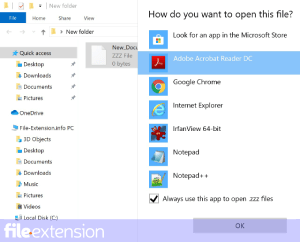
Изменить приложение по умолчанию в Windows
- Нажатие правой кнопки мыши на APEX откроет меню, из которого вы должны выбрать опцию Открыть с помощью
- Нажмите Выбрать другое приложение и затем выберите опцию Еще приложения
- Чтобы завершить процесс, выберите Найти другое приложение на этом. и с помощью проводника выберите папку Awave Studio. Подтвердите, Всегда использовать это приложение для открытия APEX файлы и нажав кнопку OK .
Изменить приложение по умолчанию в Mac OS
- Нажав правую кнопку мыши на выбранном файле APEX, откройте меню файла и выберите Информация.
- Найдите опцию Открыть с помощью — щелкните заголовок, если он скрыт
- Выберите Awave Studio и нажмите Изменить для всех .
- Должно появиться окно с сообщением, что это изменение будет применено ко всем файлам с расширением APEX. Нажимая Вперед , вы подтверждаете свой выбор.
Шаг 4. Убедитесь, что APEX не неисправен
Если проблема по-прежнему возникает после выполнения шагов 1-3, проверьте, является ли файл APEX действительным. Вероятно, файл поврежден и, следовательно, недоступен.

1. APEX может быть заражен вредоносным ПО — обязательно проверьте его антивирусом.
Если APEX действительно заражен, возможно, вредоносное ПО блокирует его открытие. Рекомендуется как можно скорее сканировать систему на наличие вирусов и вредоносных программ или использовать онлайн-антивирусный сканер. APEX файл инфицирован вредоносным ПО? Следуйте инструкциям антивирусного программного обеспечения.
2. Убедитесь, что файл с расширением APEX завершен и не содержит ошибок
Вы получили APEX файл от другого человека? Попросите его / ее отправить еще раз. В процессе копирования файла могут возникнуть ошибки, делающие файл неполным или поврежденным. Это может быть источником проблем с файлом. При загрузке файла с расширением APEX из Интернета может произойти ошибка, приводящая к неполному файлу. Попробуйте загрузить файл еще раз.
3. Проверьте, есть ли у вашей учетной записи административные права
Некоторые файлы требуют повышенных прав доступа для их открытия. Выйдите из своей текущей учетной записи и войдите в учетную запись с достаточными правами доступа. Затем откройте файл AVM Sample Studio Bank.
4. Убедитесь, что ваше устройство соответствует требованиям для возможности открытия Awave Studio
Если система перегружена, она может не справиться с программой, которую вы используете для открытия файлов с расширением APEX. В этом случае закройте другие приложения.
5. Убедитесь, что ваша операционная система и драйверы обновлены
Регулярно обновляемая система, драйверы и программы обеспечивают безопасность вашего компьютера. Это также может предотвратить проблемы с файлами AVM Sample Studio Bank. Возможно, файлы APEX работают правильно с обновленным программным обеспечением, которое устраняет некоторые системные ошибки.
Вы хотите помочь?
Если у Вас есть дополнительная информация о расширение файла APEX мы будем признательны, если Вы поделитесь ею с пользователями нашего сайта. Воспользуйтесь формуляром, находящимся здесь и отправьте нам свою информацию о файле APEX.